Many strata managers and building owners assume that if windows have locks, they’re compliant with NSW window safety laws. This assumption is costly and dangerous. A window lock and a window restrictor are fundamentally different devices with different purposes. A lock prevents windows opening completely; a restrictor limits how far they can open. NSW law requires devices that restrict the opening to less than 125mm and resist 250 newtons of force. Some purpose-rated locks can meet that test, but most ordinary window locks and latches were never designed for it. If your building is relying on standard locks, it’s likely non-compliant even though residents can’t fully open the windows. This distinction has real legal and safety consequences, and understanding it is critical for building compliance and child safety.
What Is a Window Restrictor?
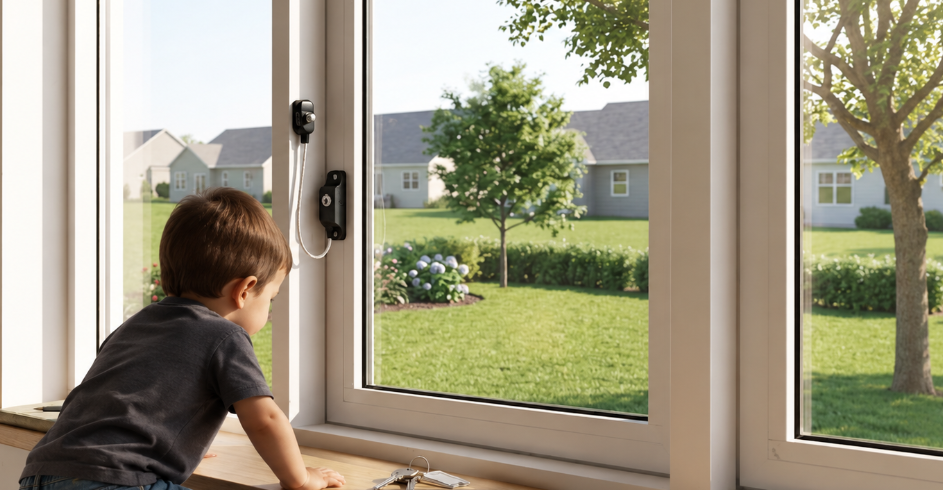
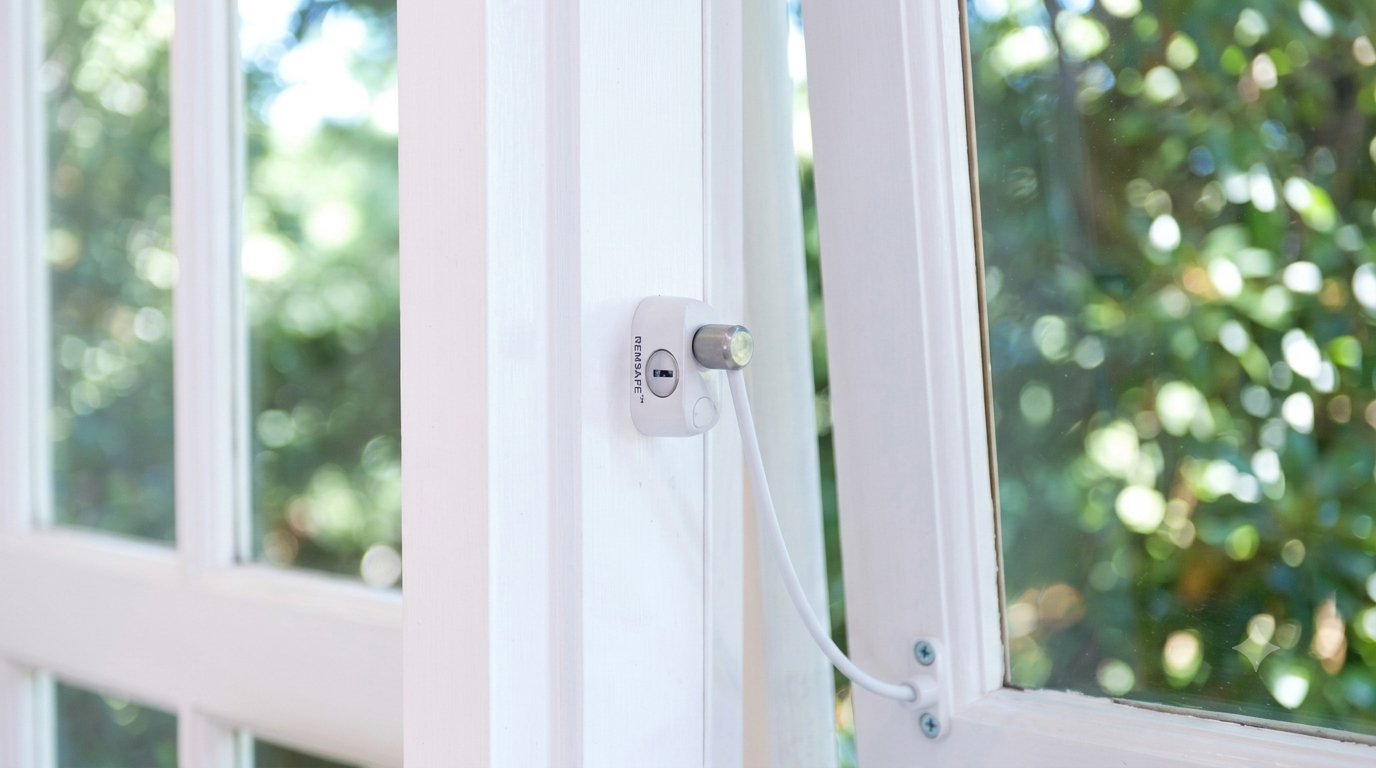
A window restrictor is a safety device designed specifically to limit how far a window can open. It allows the window to open enough for ventilation–typically up to 12.5 centimetres–but prevents a child from opening it wide enough to fall through. Restrictors come in several types: chain restrictors (a chain attached to the window frame that restricts movement), push-button restrictors (operated by a button to allow full opening when needed), key-operated restrictors (requiring a key to open fully), and fixed restrictors (permanently limiting opening).
The critical technical requirement comes from NSW strata law, and AS 5203-2016 sets out how to test it: with the device engaged, the window must not allow a 125mm (12.5 centimetre) sphere to pass through — during and after 250 newtons of force is applied. In other words, the device must both limit the gap and hold that limit under roughly a 25-kilogram push. This isn’t arbitrary–the 12.5cm gap is based on child safety research showing that a gap of this size prevents fall-through risk while allowing sufficient ventilation.
What Is a Window Lock?
A window lock is a security device that prevents unauthorised opening of a window. It’s designed to secure the window in either fully closed or fully open position, depending on the lock type. Traditional casement window locks typically allow the window to be closed and locked in that position. Some sliding window locks can be set to allow partial opening while preventing further movement, but that’s not their primary purpose. The lock’s function is security–preventing break-ins and unauthorised access.
Window locks vary widely in design and mechanism. Some are simple latches, others are multi-point locks. They operate on different principles than safety restrictors. A lock’s primary obligation is security; a restrictor’s is child safety. Confusing the two–assuming a lock provides the same safety benefit as a restrictor–is a compliance mistake that puts buildings at legal risk and undermines child safety.
Why Window Locks Alone Don’t Meet NSW Compliance Requirements
NSW window safety regulations specifically require window safety devices that limit opening gap to maximum 12.5 centimetres. A lock that merely prevents full opening doesn’t necessarily meet this specification. Many window locks allow opening to 30, 40, or 50 centimetres–wide enough for a child to potentially fall through. The lock prevents the window opening further, but the gap already achieved is larger than the regulatory maximum. This means a window with a lock but no restrictor fails compliance even though it’s physically prevented from fully opening.
Additionally, the legal test is about strength under load. A complying device must resist 250 newtons of outward force — through its mechanism, its fixings and the frame it anchors into. Locks are engineered for security against entry from outside, not for holding a restricted opening against sustained force from inside, and most have never been tested for it.
From a regulatory perspective, compliance is about performance, and AS 5203-2016 is the standard used to test it. During inspection, the opening is checked against the 125mm limit, and the device, its fixings and the frame are assessed against the 250-newton requirement. Most ordinary locks fail one or both. Compliance means devices designed and tested for this specific job — which purpose-built restrictors are, and standard locks generally are not.
The 4 Types of Approved Window Restrictors
Chain Restrictors consist of a chain attached to the window frame that limits opening distance. When the window opens, the chain extends until it reaches maximum length, preventing further opening. Chain restrictors are affordable, reliable, and non-intrusive–they don’t affect the window’s appearance significantly. The disadvantage is that the chain is visible and can be damaged or deliberately cut. Maintenance involves checking the chain isn’t corroded or broken. Force requirements vary depending on chain tension. Chain restrictors work well for casement windows and are popular in residential buildings.
Push-Button Restrictors allow normal ventilation through the limited 12.5cm gap, but include a button that must be pressed to allow the window to open fully. This is ideal for situations where full opening is occasionally needed–for example, to clean windows or provide emergency exit. When the button isn’t pressed, the window stops at 12.5cm. The advantage is that adults can easily access full opening when needed, but the restrictor prevents accidental or unsupervised full opening by children. The disadvantage is that determined individuals can press the button, though this requires intentional action. Push-button restrictors are becoming increasingly popular in residential buildings because they balance safety with practical usability.
Key-Operated Restrictors require a key to unlock full opening. The window operates at restricted opening (typically 12.5cm) unless a key is used to unlock it for full opening. This provides maximum safety because opening is restricted unless an adult with a key deliberately unlocks it. The disadvantage is that keys must be managed, and emergency access is more complicated if someone doesn’t have the key. Key-operated restrictors are often used in buildings with children in care facilities or educational settings where controlled access is important.
Fixed Restrictors permanently limit opening to the maximum gap, typically 12.5cm. These devices have no unlock mechanism–the window simply cannot open beyond the restricted gap. They’re the most reliable (nothing to unlock or break) and the most affordable, but they’re also the least flexible. If the building needs to upgrade or remove the restrictor later, it requires device replacement. Fixed restrictors are appropriate for buildings where full window opening isn’t needed or for specific high-risk windows.
Which Windows in Your Building Need Restrictors?
Not every window in every building requires a restrictor. The requirement applies specifically to windows where the sill height is less than 1.7 metres above the internal floor level AND the window is more than 2 metres above external ground level. This geometric definition means that upper-storey windows in a building are often above the ground-level threshold and don’t require devices. Ground-floor windows might not require devices if the sill height is already high enough internally.
The measurements must be taken correctly. Internal sill height is measured from the finished floor level to the bottom edge of the window opening. External ground level is the actual ground surface outside. In buildings with balconies, the ground level can be measured from the balcony surface if that’s the relevant external reference. A certified inspector knows how to take these measurements accurately. The mistake many building managers make is assuming all windows below a certain floor need devices or that all windows on a floor need devices. In reality, each window must be individually assessed.
This is why a comprehensive inspection is essential. An inspector will measure every window in question, calculate whether it meets the geometric criteria, and determine which windows require devices. In a typical 10-storey apartment building, for example, ground-floor windows might require restrictors, but upper floors often don’t. In a 3-storey townhouse, ground-floor windows typically require devices but upper floors don’t. The only way to know is to have each window properly assessed by someone qualified to take accurate measurements and interpret the regulations.
Can You Install Window Restrictors Yourself?
Technically, yes–restrictors are physical devices that can be installed by anyone with basic tools. However,
self-installation creates significant problems. First, the compliance certificate is only valid if issued by a certified inspector. If you install restrictors yourself and don’t have an inspector verify them, you have no formal compliance certification. If Fair Trading NSW audits your building, a self-installed restrictor without certification isn’t proof of compliance. If a child is injured and a lawyer reviews your inspection records, a self-installed restrictor without professional certification demonstrates negligence.
Second, installation requires understanding of AS 5203-2016 specifications. The restrictor must be installed at the correct position, with correct fastening (typically through the window frame into solid wood or metal), and must function within the standard’s force and gap specifications. Improper installation can result in a device that looks correct but doesn’t meet technical requirements. An inspector testing a poorly installed restrictor will find it non-compliant.
Third, compliance isn’t just about the device–it’s about documentation. A formal compliance certificate requires an inspector to test the device, measure opening gap, verify force operation, check frame integrity, and document everything. A self-installed restrictor has none of this documentation. When you renew building insurance or sell units in the building, insurers and purchasers want to see a formal compliance certificate. A self-installed device won’t satisfy them.
Many inspectors offer bundle services–they inspect the building, identify which windows need devices, and install restrictors the same day. This ensures installation meets standards and the building immediately receives a valid compliance certificate. While self-installation might save money on labour, it creates compliance and liability risks that far outweigh any savings. For strata buildings with common property windows, certified installation is the standard approach and is the only approach that provides proper compliance documentation.
How Much Does Window Restrictor Installation Cost in Sydney?
Costs vary based on building size, window type, and restrictor type chosen. Haven quotes installation fixed per window before any work, with per-building rates for multi-unit properties.
The initial inspection typically costs depends on the building size. If non-compliance is found and installation is required, that’s an additional charge. Some inspectors include the inspection cost if you proceed with installation; others charge separately. For annual re-inspections once the building is compliant, costs are typically lower since the inspection is just verifying existing devices rather than installing new ones.
Factors affecting cost include the number of windows needing devices, restrictor type (chain restrictors are cheapest, key-operated are more expensive), window type (casement vs sliding windows require different installation approaches), and building access complexity (high-rise buildings requiring special equipment cost more). However, when you compare the cost of a proper inspection and installation against potential Fair Trading NSW penalties (thousands of dollars), insurance complications, or civil liability from an injury (potentially hundreds of thousands), the compliance investment is minimal.
Bundling inspection and installation is often cost-effective. If you hire an inspector who also installs, they can complete both in one visit, reducing travel time and administrative overhead. They can also identify any issues with existing windows (frame damage, glass problems) that might affect installation and remediate them on the same visit. For buildings managing multiple properties, negotiating an annual compliance programme across several buildings often reduces per-building costs significantly compared to one-off inspections.
What Your Compliance Certificate Covers
A formal window safety compliance certificate should document exactly which windows were inspected, which passed, and which required remediation. It should specify the standard to which the inspection was conducted (AS 5203-2016), the inspection date, and the inspector’s qualifications. The certificate should detail any devices installed or verified, including the device type and location. Test results–opening gap measurements and force test results–should be documented. Any non-compliant windows should be noted with remediation recommendations.
The certificate is typically valid for 12 months from the inspection date. After 12 months, a new inspection and certificate are required to maintain compliance. The certificate should include the inspector’s contact details and professional indemnity insurance information. You should retain the certificate in your strata records–it’s a legal document that proves compliance at a specific point in time. If Fair Trading NSW audits your building or if a legal issue arises, the compliance certificate is your primary defence showing that you took reasonable steps to ensure safety.
A certificate is only as valuable as the inspector who issued it. An invalid certificate from an unqualified inspector provides no legal protection. This is why choosing a qualified inspector–one certified to AS 5203-2016, properly insured, and experienced with residential buildings–is so critical. The certificate is your compliance proof, and it must be issued by someone who’s genuinely qualified to inspect and certify.
Making the Choice: Restrictors vs Locks
The choice isn’t really “restrictors vs locks”–it’s “compliance vs non-compliance.” NSW law requires restrictors on specified windows. Locks, no matter how secure, don’t meet that requirement. If your building currently has locks but no restrictors, you need to arrange an inspection and install approved restrictors on windows that meet the geometric criteria. This is a legal obligation, not optional.
Contact a certified window safety inspector to assess your building, determine which windows need devices, and ensure proper installation and documentation. Haven Compliance provides comprehensive inspections, professional installation, and formal compliance certification for Sydney buildings.